
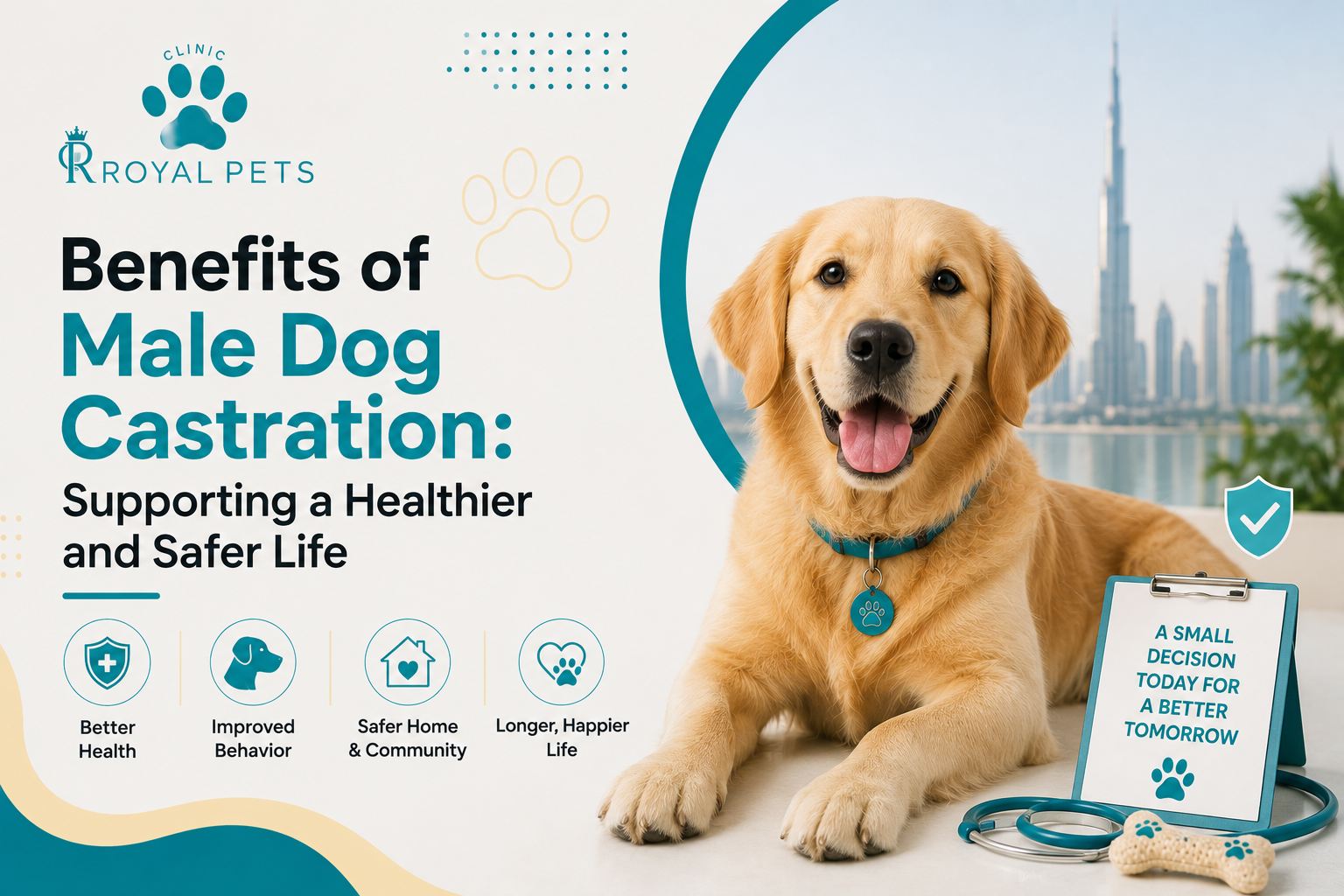
Choosing whether to castrate your male dog is an important decision that deserves careful thought and professional veterinary guidance. The benefits of male dog castration can include preventing unwanted litters, eliminating the risk of testicular cancer, reducing certain prostate problems, and improving some hormone-driven behaviours.
However, every dog is different. His breed, age, size, health, lifestyle, temperament, and stage of physical development should all be considered before surgery.
At Royal Pets Veterinary Clinic Dubai, pet owners receive individual guidance rather than a one-size-fits-all recommendation. Located in the heart of Garhoud, Dubai, the clinic combines modern veterinary care with a gentle, compassionate approach designed to keep every pet comfortable, safe, and well cared for.
What Is Male Dog Castration?
Male dog castration, commonly called neutering, is a surgical procedure in which the testicles are removed under general anaesthesia. The procedure permanently prevents the dog from reproducing and significantly reduces the production of testosterone.
Testosterone influences fertility, mating drive, and certain behaviours such as roaming, mounting, urine marking, and competition with other male dogs. Reducing this hormone may therefore provide health, behavioural, and practical advantages.
Castration is a common veterinary procedure, but that does not mean the same recommendation is appropriate for every dog. A veterinary examination should always come first so that the benefits, possible risks, and appropriate timing can be evaluated properly.
What Are the Main Benefits of Male Dog Castration?
The decision to castrate a dog is often based on a combination of health, behaviour, lifestyle, and responsible pet ownership. Understanding the possible advantages can help owners have a more productive conversation with their veterinarian.
Eliminating the Risk of Testicular Cancer
One of the clearest health benefits of castration is that removing the testicles eliminates the possibility of developing tumours within them.
This can be especially important for dogs with cryptorchidism, a condition in which one or both testicles fail to descend normally into the scrotum. A retained testicle may be located in the groin or abdomen and has a higher risk of developing tumours or painful twisting, known as testicular torsion. Veterinary guidance recommends assessing retained testicles carefully and removing them when medically appropriate.
If you cannot feel both of your dog’s testicles, or you are uncertain whether they have descended, an examination at Royal Pets Veterinary Clinic Dubai can help determine the safest next step.
Reducing Benign Prostate Enlargement
The prostate is a reproductive gland located near the bladder and bowel. In uncastrated male dogs, continued exposure to testosterone can cause the prostate to become enlarged over time. This is known as benign prostatic hyperplasia.
An enlarged prostate may lead to discomfort, difficulty passing stool, urinary changes, or blood in the urine or reproductive discharge. Castration reduces testosterone production and can significantly reduce the risk or severity of hormone-related prostate enlargement.
It is important to remember that castration does not prevent every prostate condition. Changes in urination, bowel movements, posture, or comfort still require veterinary investigation.
Reducing Certain Hormone-Dependent Conditions
Male dog castration may also reduce the likelihood of certain conditions influenced by testosterone, including some types of perianal tumours. Castration may also be recommended as part of the management plan for selected dogs with reproductive or perineal conditions.
The correct treatment depends on the dog’s diagnosis. A lump near the tail, swelling around the anus, difficulty passing stool, or discomfort should never be assumed to be a simple hormonal issue.
Royal Pets Veterinary Clinic Dubai provides comprehensive examinations and advanced diagnostic support, including X-rays, ultrasound, and in-house laboratory testing when clinically appropriate.
Preventing Testicular Torsion
Testicular torsion occurs when a testicle twists around its supporting tissues and restricts its own blood supply. It is painful and requires urgent veterinary treatment.
Once the testicles have been removed through castration, testicular torsion can no longer occur. This benefit is particularly relevant to dogs with an undescended testicle because retained testicles may be more vulnerable to twisting.
Preventing Unwanted Litters
Castration permanently prevents a male dog from impregnating a female dog. This is particularly valuable for owners who do not plan to participate in carefully managed, responsible breeding.
Even a well-behaved dog may react strongly when he detects a nearby female in heat. He may attempt to escape through an open door, climb a fence, pull away during a walk, or travel a significant distance to reach her.
Preventing accidental mating protects owners from the challenges of an unplanned litter and supports responsible control of the dog population. Professional veterinary guidance identifies reproductive control as one of the central reasons for neutering.
Castration does not replace responsible supervision, secure fencing, proper identification, or leash control, but it can remove the possibility of the dog producing an unwanted litter.
Behavioural Benefits of Male Dog Castration
Behavioural changes are often among the most discussed benefits of male dog castration. Castration can help reduce behaviours strongly influenced by reproductive hormones, but owners should maintain realistic expectations.
The procedure is not a substitute for socialisation, training, exercise, environmental enrichment, or professional behavioural support.
Less Roaming and Escaping
An uncastrated male dog may be strongly motivated to search for a female in heat. This can cause wandering, escaping, poor recall, and persistent attempts to leave the home or garden.
Castration may reduce this reproductive drive, helping some dogs become less likely to roam in search of a mate. Reducing roaming may also lower exposure to road accidents, getting lost, conflicts with other dogs, and other outdoor dangers.
However, dogs may also wander because of boredom, fear, insufficient exercise, curiosity, or an insecure property. These causes must be addressed separately.
Less Urine Marking
Urine marking is a form of communication in which dogs leave small amounts of urine on objects or surfaces. Testosterone can influence this behaviour, particularly when a male dog is responding to other animals or unfamiliar environments.
Castration may reduce marking when it is mainly hormone-driven. It may not stop the behaviour completely if it has become a long-standing habit or is connected to anxiety, stress, or territorial insecurity.
A sudden increase in urination should be assessed by a veterinarian because urinary infections, bladder problems, diabetes, kidney disease, and other medical conditions can also change a dog’s toileting habits.
Reduced Mounting Behaviour
Mounting can be connected to sexual hormones, especially in adolescent and uncastrated male dogs. Castration may reduce this type of reproductive mounting.
Not all mounting is sexual, however. Dogs may also mount because of excitement, stress, over-stimulation, play, frustration, or learned behaviour. When mounting continues after castration, training and behavioural management may still be needed.
Possible Reduction in Hormone-Driven Conflict
Castration may reduce certain forms of competition or conflict between male dogs when testosterone and access to females are important triggers.
It should not be described as a guaranteed cure for aggression. Aggression may arise from fear, pain, anxiety, resource guarding, frustration, insufficient socialisation, or previous experiences. In some dogs, removing reproductive hormones may have little effect on these underlying causes.
Veterinary and animal-welfare guidance indicates that behaviours such as roaming, mounting, fighting, or urine marking may decrease after neutering, but personality and non-hormonal behavioural problems do not automatically change.
If your dog is growling, lunging, biting, guarding objects, or reacting fearfully, contact Royal Pets Veterinary Clinic Dubai for an assessment before assuming castration alone will solve the problem.
Will Castration Change Your Dog’s Personality?
Many owners worry that castration will make their dog less playful, affectionate, confident, or energetic. The procedure does not erase a dog’s personality or the relationship he has developed with his family.
Your dog will still need:
- Daily physical activity appropriate for his health and breed.
- Mental stimulation and enrichment.
- Positive, consistent training.
- Social interaction and companionship.
- A balanced diet and weight monitoring.
- Regular preventive veterinary care.
What may change is the intensity of certain reproductive behaviours. A dog who is less distracted by the scent of females may appear more settled or attentive, but this should not be confused with an automatic personality transformation.
Are There Risks or Disadvantages?
Castration offers important potential advantages, but it is still a surgical procedure and should be approached responsibly.
Possible considerations include:
- Risks related to general anaesthesia.
- Bleeding, swelling, or infection.
- Temporary pain or discomfort.
- Damage to the incision from licking or excessive activity.
- A greater tendency toward weight gain.
- The permanent loss of breeding ability.
- Possible breed- and age-related health considerations.
Neutered dogs may require an adjustment to their calorie intake because their energy needs or appetite can change. Portion control, regular exercise, and body-condition monitoring can help prevent unwanted weight gain.
The timing of castration may also be important, particularly for large and giant breeds that take longer to reach skeletal maturity. Current professional guidance supports making the decision according to the individual dog rather than applying one fixed age to every breed.
What Is the Best Age to Castrate a Male Dog?
There is no single age that is ideal for every male dog.
The veterinarian may consider:
- Breed and expected adult size.
- Current weight and growth stage.
- Skeletal maturity.
- General health.
- Whether both testicles have descended.
- Existing medical conditions.
- Behaviour and living environment.
- Risk of accidental mating.
- Future breeding plans.
Smaller dogs often mature earlier than large and giant breeds. Some dogs may benefit from waiting until more physical development has taken place, while earlier surgery may be recommended when there is a medical concern such as an undescended or abnormal testicle.
Adult and older dogs may also be suitable for castration. Their general health, blood-test results, medical history, and anaesthetic risk should be evaluated before the procedure.
A comprehensive pet examination at Royal Pets Veterinary Clinic Dubai allows the veterinary team to recommend timing based on your dog’s individual needs rather than a general rule found online.
What Happens Before Male Dog Castration?
Before surgery, your dog should receive a veterinary examination. The team may ask about his medical history, medications, previous reactions to anaesthesia, appetite, activity, and any recent health or behavioural changes.
Pre-operative blood testing may be recommended to assess factors such as blood-cell levels and organ function. Older dogs or dogs with existing medical concerns may require additional investigation.
Royal Pets Veterinary Clinic Dubai has an in-house laboratory and advanced diagnostic capabilities, including X-ray and ultrasound. These services allow the veterinary team to gather additional information when necessary without automatically performing tests that your dog does not need.
Owners will also receive instructions about fasting, medication, admission, and collection. Follow the instructions given specifically for your dog rather than relying on a general schedule.
Recovery and Aftercare
After castration, your dog will need a quiet, clean recovery area and close supervision. Some sleepiness or reduced appetite may occur during the initial recovery from anaesthesia.
Most dogs need restricted activity while the incision heals. This commonly means short leash walks, no running, no jumping, no rough play, and no swimming or bathing until the veterinary team confirms that it is safe. Many dogs require approximately 7–14 days of controlled activity, although individual instructions may vary.
Your dog may need an Elizabethan collar or suitable recovery garment to prevent licking. Only give medication prescribed or approved by the veterinarian. Human pain medicines can be dangerous to dogs.
Contact the clinic promptly if you notice:
- Persistent bleeding.
- Increasing redness or swelling.
- Discharge or an unpleasant smell.
- Opening of the incision.
- Repeated vomiting.
- Severe discomfort.
- Difficulty breathing.
- Collapse or extreme weakness.
- Difficulty passing urine.
- Any unexpected deterioration.
Following the aftercare plan carefully gives your dog the best opportunity for a comfortable and uncomplicated recovery.
Why Choose Royal Pets Veterinary Clinic Dubai?
The decision to castrate your dog should begin with trust, clear information, and an understanding of his individual needs.
Royal Pets Veterinary Clinic Dubai is a warm and friendly veterinary clinic located in Garhoud. It is more than a medical space—it is a community for pet lovers who want thoughtful, compassionate care for their furry family members.
The clinic offers:
- Comprehensive pet examinations tailored to age and lifestyle.
- Advanced diagnostics, including X-ray, ultrasound, and an in-house laboratory.
- Veterinary surgery and preventive medicine.
- Professional dental care and grooming.
- Comfortable pet boarding.
- A fully stocked pet shop.
- Gentle care designed to reduce stress during every visit.
From the first consultation to surgery and post-operative care, the team takes time to assess your dog, answer your questions, and explain the available options clearly.
At Royal Pets Veterinary Clinic Dubai, every pet is treated like royalty—with patience, attention, and genuine care.
Give Your Dog the Benefit of an Informed Decision
The benefits of male dog castration can be significant. The procedure can prevent unwanted litters, eliminate testicular cancer and torsion, reduce benign prostate enlargement, and help decrease certain hormone-driven behaviours.
The most important step, however, is determining whether castration is suitable for your individual dog and choosing the right time to perform it.
Do not make the decision based only on your dog’s age or the experiences of other pet owners. His breed, size, health, behaviour, physical development, and lifestyle all matter.
Contact Royal Pets Veterinary Clinic Dubai to arrange a personalised veterinary consultation in Garhoud. The team will examine your dog, discuss the potential benefits and risks, and help you choose the safest and most appropriate path for his long-term health and happiness.
Leave a Reply